
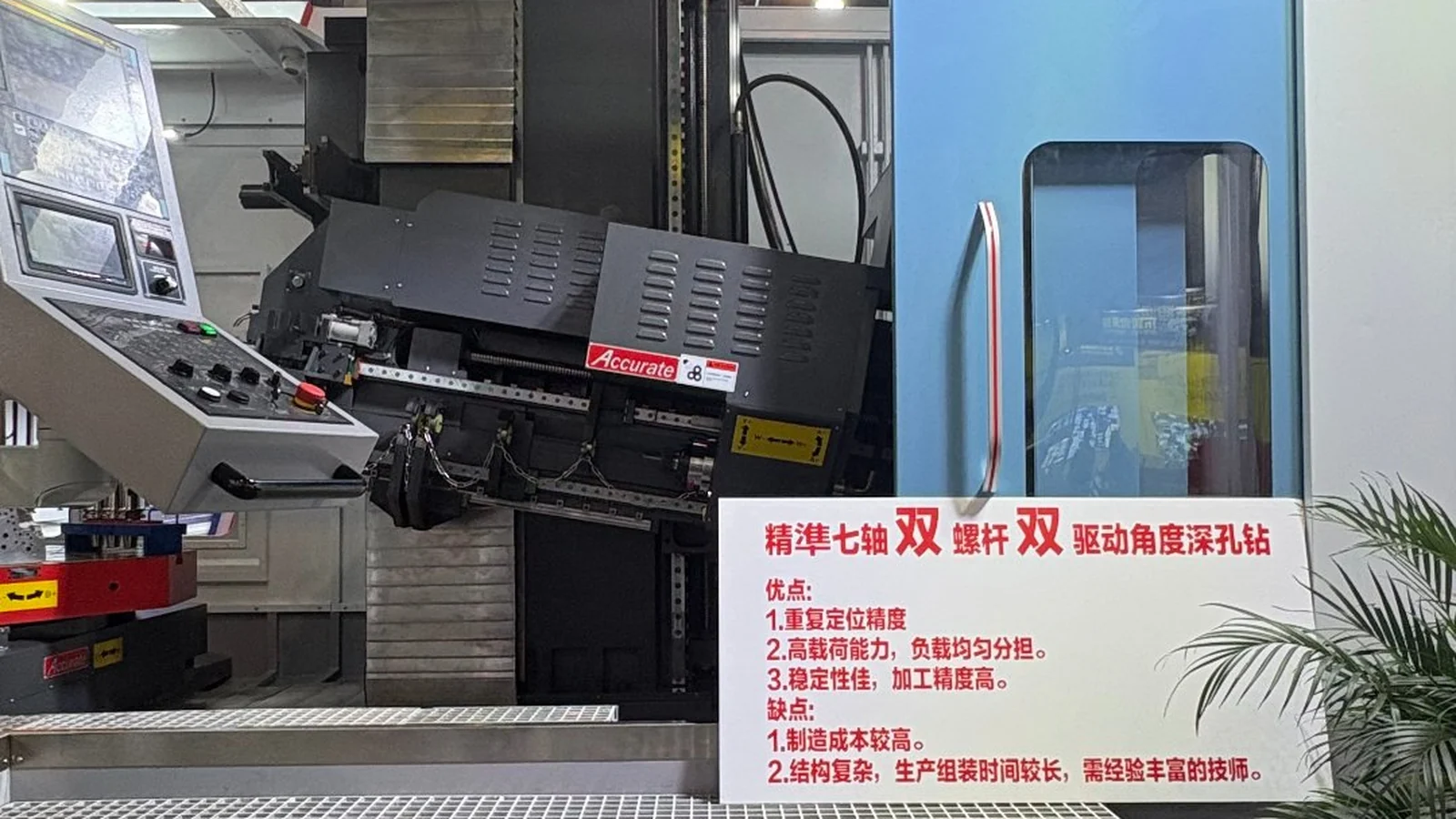
Today I went to the Dongguan machine tool show.
Automation everywhere. A little overwhelming, honestly.
I wasn’t there to sightsee. I was there for an answer to one question: we’re still climbing the five-axis hill, so how high do we actually need to go?
1. That seven-axis machine
The one that stopped me was a seven-axis machine.
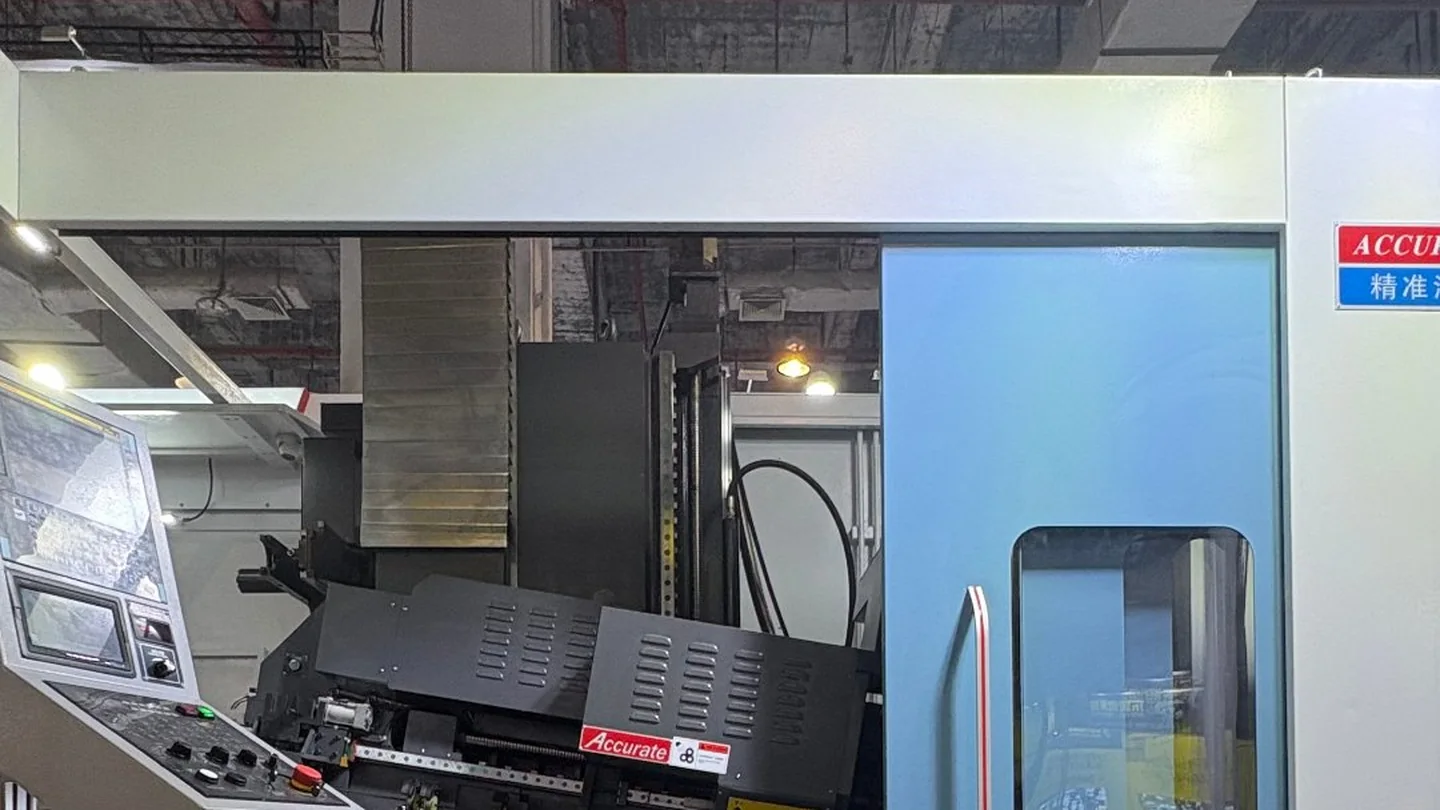
The placard read: Precision seven-axis, dual-screw dual-drive angular deep-hole drilling.
Next to it, advantages and disadvantages — not the sales-brochure version that only lists the good stuff, but laid out side by side, honestly:
Advantages: high repeatability; high load capacity, load evenly distributed; good stability, high machining accuracy.
Disadvantages: high manufacturing cost; complex structure, long assembly time, requires experienced technicians.
I stood in front of that machine for a while.
Not because it was expensive. Because of those lines under “disadvantages.”
Most machine builders bury the downside in the smallest print on the last page. This one put it right next to the upside — which tells you they know exactly what they are selling: with high-end equipment, the price and the capability arrive together.
2. The arithmetic on the way back
On the way out, one calculation kept running in my head.
Most of our shop is still 3+2. Five-axis is climbing too. And everything I saw at the show — seven-axis, automation lines — I wanted all of it. I’m being honest.
But wanting is one thing. The math is another.
First: the price gap.
Five-axis costs a lot more than three-axis. That is common knowledge. Seven-axis costs more again. And that gap is not a one-time hit — it lands on every single part you make.
Buy a machine that costs three times as much, and every part off it carries that machine’s depreciation. What the customer sees on the quote is really a shadow of what the machine cost.
Second: do these parts actually need five-axis?
My rough estimate: eight out of ten parts on the market today, 3+2 handles cleanly.
So putting that five-axis cost onto those eight-out-of-ten parts — what for?
Nothing. It’s just more expensive. The customer pays more, you carry more depreciation, and the part itself is not one bit better.
3. But the trend does not sit on the “good enough” side
If that were the whole story, the answer would be simple: 3+2 is enough, don’t buy five-axis.
It isn’t that simple.
Because this trade is heading in another direction: parts are getting harder, tolerances are getting tighter.
Five-axis machine sales have been rising year after year, and there is a reason. Parts are getting harder, and five-axis has gone from “optional” to “required.”
There is another layer: in many countries, five-axis is treated as a core asset. Why? Because a lot of high-end work — aerospace, medical, precision — can only be done on five-axis.
And five-axis today is not just about precision. It brings automation with it. A five-axis automation cell can do work, and run hours, that a manual 3+2 cannot touch.
So the trend is clear: five-axis is on the way up.
4. So “higher-end is always better” is only half true
Back to the question: is higher-end always better right now?
My answer: there is no single answer. It depends on which angle you stand at.
From the customer’s unit-price angle — 3+2 is more economical. Same part, lower quote from 3+2. The customer does not care what machine you run; they care about price and lead time. Here, “good enough” is the optimum.
From the trend angle — five-axis is necessary. Parts are getting harder, and what is good enough today may not be tomorrow. Here, “high-end” is the entry ticket.
From the shop-floor reality angle — get the eight-out-of-ten jobs done well, done steady, done profitably, before you chase the other two. Equipment is not bought to be admired; it is bought to run. One underused five-axis is worth less than three fully loaded 3+2 machines.
All three angles are right. What clashes is not the answer — it is the angle.
5. The end
So “higher-end is always better” is only half true.
High-end is not the goal. It is the means. Equipment is for taking work, not for comparing who is more advanced.
The real question is not “should I buy five-axis?” It is “what work am I going to take next, and how much machine does it take to hold it?”
A seven-axis machine is beautiful. But beautiful does not mean you should buy it.
Shake the sand out of your shoe first. Then think about how fast to run.