
The first half — Shake the Sand Out of Your Shoe: Why We Retired Two Machines — ended with the new machines not yet arrived. This is the second half: they are here.
Last night, they arrived.
Two of them, both JIAFU vertical machining centers. Two at a time, one step at a time.
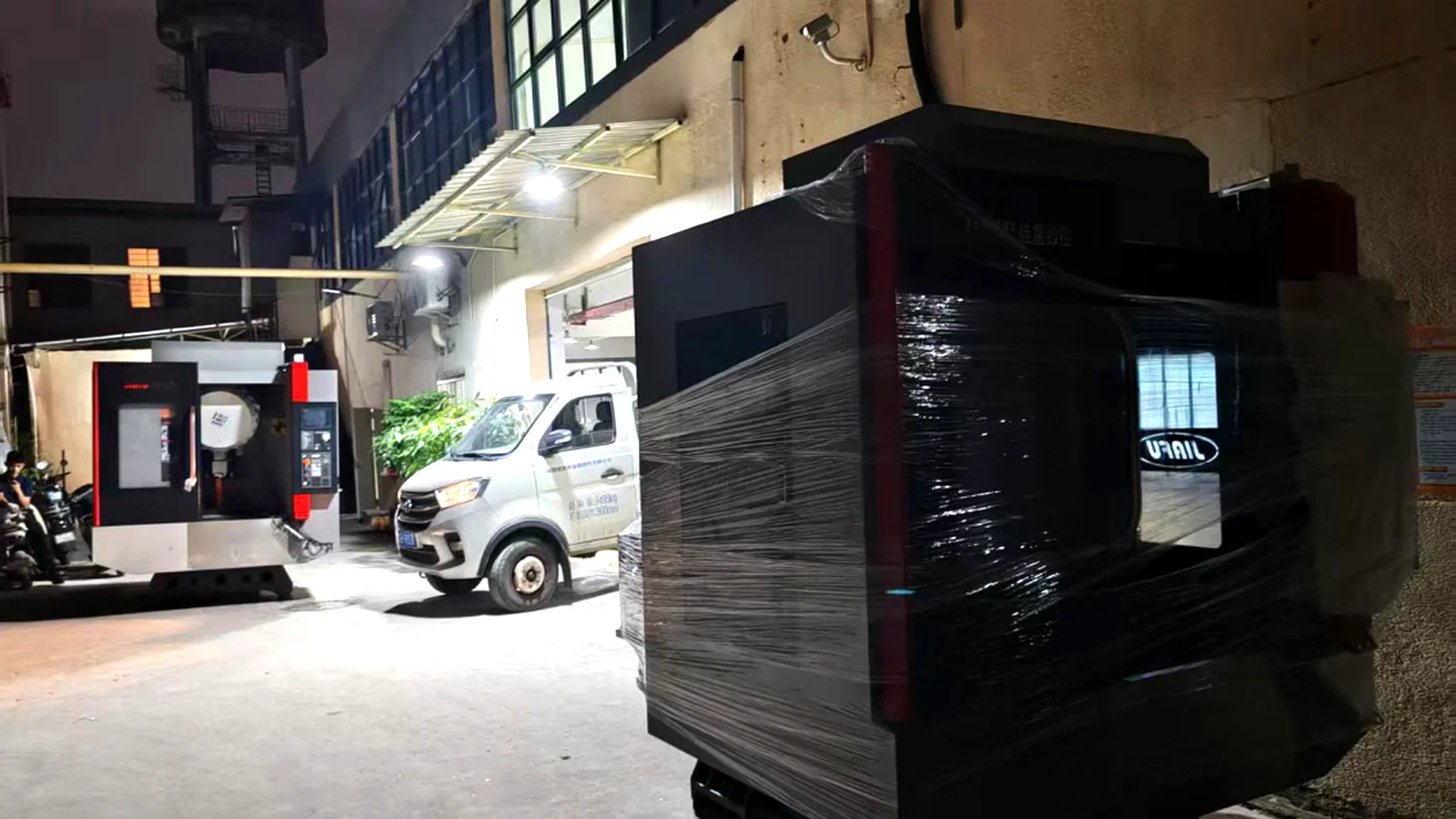
They came in still wrapped in stretch film, parked beside the building, the light already gone. Film on, road dust on the wrap.
This morning: unwrap, power on, level, run. No time to waste. We need them.
1. Why JIAFU
Outsiders think buying a machine is about price. It is about two other things: how steady it runs, and how the parts come out.
We have run JIAFU machines in this shop for years. I know their stability the hard way — part after part, shift after shift. They have earned the kind of trust that makes you order the same name again.
The two machines we are retiring are from another maker — the no-name kind. Replacing them with JIAFU was not a coin flip. It came down to one judgment: a name-brand machine runs steadier than an off-brand one, and the parts come out better. On a spec sheet, an off-brand can print numbers that look the same. Two or three years in — whether it still holds steady, whether it still holds tolerance — that is where the difference shows.
That judgment did not come from nowhere. This shop is heading into more and more precision parts — robotics, medical, aerospace, chip carriers, liquid cooling. Every one of them wants a high-precision machine. That work does not tolerate “close enough,” and it does not tolerate “depends on the day.” The machine has to hold steady first; only then do the parts come out right.
And one more thing: one step at a time. We are not greedy. Two machines now, get them running and proven, then the next batch. The worst mistake in equipment upgrades is moving too fast — bringing in another batch before you have figured out the first one, until nobody remembers which machine is supposed to do what.
2. A new machine does not just plug in
Between uncrating and actually making good parts there is a whole checklist, and none of it is optional:
- Inspection on arrival. Cosmetic, paint, any shipping damage.
- Leveling. The base has to be shimmed flat. If the machine is not level, all the accuracy in the world will not save it.
- Dry run. Power it up, run it empty, listen — spindle, ball screws, any noise that should not be there.
- Accuracy verification. Positioning, repeatability, geometric accuracy — the hard numbers that decide how fine this machine can actually cut.
- First-article trial. Put a real piece of material on it, cut it, measure it. A vendor’s spec sheet is never as convincing as a part you cut yourself.
The first four make the machine right. The last one makes it prove it.
3. The programs still need proving. The people still need setting.
After the machines land, two things grind harder than the purchase.
One is the programs. Same products, same programs. But nobody copies an old program onto a new machine and hits cycle start. Tool numbers, work offsets, controller habits — they all drift a little. So every program gets a trial run before I trust it. Cut it, measure it — then it counts.
Two is the people. The machines are new; the operators are not. At the start, the senior machinists do the setup — the ones with years on their hands, the ones who can hear a machine that is not right. The new guys cannot step in yet.
So replacing a machine: writing the check is only the beginning. Turning a new machine into real capacity is all the trials and tweaks after it.
4. What we actually bought
Last time I said the old machines were really burning money on three things: downtime, scrap, and missed delivery promises.
This time the math is not “what it cost.” It is what we bought back.
The most concrete one: the high-precision work the old machines could not touch.
An unstable machine, when a tight-tolerance part shows up, turns your stomach — you do not know if it will come out right until you measure it, and after you measure, you sort. That work, you either turn it down or you take it and sweat. A new machine is different. The stability is just there. Tight-tolerance work — you take it, you quote it.
- The old machines stopped every other day; the new ones keep running
- The old ones sent parts back for rework; the new ones come out right the first time
- The old ones could not quote the precision; the new ones can
Those three lines are what we actually paid for.
5. The second half
Shaking the sand out of a shoe takes two steps: decide to do it, then actually do it.
The last article was the first step. This one is the second. Sand in your shoe makes every step hurt; once it is out, you walk again.
But this is not a one-time thing.
Machines age. Accuracy drifts. That is physics, and nobody argues with physics. So every year from now on, we will do the same trade-in — not to chase what is new, but to keep up with the times. A person keeps sharpening their own skills; the equipment has to keep up too.
That line is what this replacement really taught me.